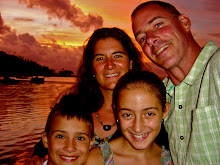
We started school in early September on the shores of Lake Tahoe. We began with a short examination of Robert Frost’s The Road Not Taken. (“…Two roads diverged in a wood, and I – I took the one less traveled by, And that has made all the difference.”) We figured it a terrific introduction to a year of new lessons, new places and a radically different curriculum.
We have tried all along to follow the Bainbridge Island school schedule, taking breaks here and there based on our travel schedule or other events that made school unworkable. We will end on July 1, a little later than the BI kids. We have generally worked in the mornings five days a week, spending between 3 and 5 hours per day covering core subjects like math, writing/language arts and reading. We’ve devoted most school day afternoons to fun and errands, with a liberal dose of projects and/or field visits to complement the social studies and or science topics. See below for more details on the individual topics we covered in each core subject.

Celebrating Diwali, Fiji
From early on, Ben and I tag teamed teaching. Ben played the dual roles of math teacher and principal/attitude police while I took on language arts and writing. We collaborated on social studies and science, depending on our own skill sets. This separation of roles worked well, not only because each child was given one-on-one attention for the entire school day but also because it allowed for continuity in teaching. Ben and I each knew full well where each child was on a particular subject or project, what each child’s strengths/weaknesses were, and what was the best way to help him or her learn.
Here is a summary of the specific topics we covered under each subject:
Math
From the beginning we heard that it would be crucial to keep Tica and Ian up to date in math, so Ben and I decided to adopt a very standard and very structured math curriculum. Thanks to a homeschooler parent on Bainbridge, we were turned onto ALEKS (www.aleks.com), an on line math program which offers math curriculums based on grade level and the math curriculum requirements of the child’s home state (in our case, WA). Here is how it works.

Cultural Studies, Wat Po, Thailand
Upon signing up for a course, the student is given a detailed assessment in order to determine what math topics he or she understands. With that information, the computer then generates a math course for the child to follow using a pie chart format. The slices of the pie represent general math topics like geometry, whole numbers, fractions, algebra, decimals/percent, etc. Each slice contains a variety of subtopics that the child must cover, and he or she must “finish” all the slices of the pie in order to complete the curriculum. The student must also master certain subtopics in order to go on to others.

ALEKS in a mobile classroom, New Zealand
In order to master a certain math topic, the student must correctly answer four or five math questions on that topic. Explanations are always a click away and the computer will continue to generate problems until the student can answer four or five in a row. The student must then revisit each topic in review questions at the beginning of each new learning session. Finally, ALEKS generates a mandatory and unscheduled examinations with 20 to 25 questions based on the same topics. The topics will only be added to the completed pie slice if the student can answer these questions correctly the first time.
Within that framework, the child almost always has choices as far as what subtopic he or she wants to cover on a certain day. For example, if Tica didn’t want to do any geometry subjects on a particular day, she could just click on another pie slice and work on those subtopics. She still had to eventually complete all the geometry subtopics though, in order to pass out of 6th grade math.
ALEKS also has a comprehensive reporting system that allows the student and his or her teacher to monitor the student’s progress, including the amount of time actually spent working on the curriculum. We figured this would be helpful if we were asked by the BI School District to provide evidence of the schoolwork we’ve done this year.
The only drawback to ALEKS was that we had to have a reliable and relatively fast internet connection in order for Ben and the kids to get their work done. This has not always been possible or has required us to move or make alternate study arrangements, like doing school in the neighborhood Starbucks in Bangkok. Generally though, we tried to do around 45 minutes of math each school day. While this doesn’t seem like much, it proved to be more than sufficient – “plenty math” as a Fijian might say.

School work on a cold summer's day, Tasmania
Starting in September, Ian started the fourth grade math curriculum in ALEKS. He completed it during our stay in Bangkok, and as of this writing in early June, he is 92 percent of the way through the 5th grade math curriculum. The fourth grade ALEKS course includes an additional feature called Quick Tables, which uses on line flash cards and games to help the child master his or her math facts for addition, subtraction, multiplication and division. Between that and the standard curriculum, Ian’s basic skills improved dramatically.

Fractions on the Ferry, Fiji
Tica completed ALEKS’ 6th grade math course a little later than Ian did, mostly due to the fact that this course included significantly more topics than fourth grade math. She finished while we were in Christchurch and is now more than 80 percent of the way through 7th grade math. Ben and I were most impressed with the level of difficulty of the topics that Tica was expected to master, including complex algebraic word problems and the Pythagorean Theorem. We are curious to see if this training will get her into an advanced math class this fall.
And Some Other Stuff Too
Ben and I were much more creative in putting together a curriculum for the remaining subjects . Although we tried to be sure to cover specific things and used some standard textbooks in places, we generally adapted our daily lesson plans to our surroundings, the weather at the time, and new ideas. I personally found this part of teaching to be a lot of fun. I would also like to think that this more non-traditional approach made school more interesting for the kids too and fomented the idea that learning is a life long process and that every day provides multiple opportunities to enrich oneself.
Language Arts
Both kids completed a number of writing assignments this year, including creative writing, persuasive writing, narrative writing, and others. Many of these are posted on this blog. We tried to have a daily journal writing requirement as well but our ever changing schedule and the kids’ differing interests in writing made this a tough go.

Lots of writing
We used some textbooks/workbooks for grammar and writing skills. Both books on writing skills walked the kids at grade-appropriate levels through the writing process (e.g., prewriting, drafting, revising, proofreading, publishing) and provided a good framework in which to work on on-going writing project.
Having a lesson or two to do each day made working easier for Ian so we worked through a second workbook on language arts skills this spring. Here we worked on identifying part of speech, parts of a sentence, punctuation and other nuts and bolts grammar questions that Ian will need going into the fifth grade.
Tica completed a textbook that walked her through the sixth grade level of the writing process. We used these techniques on various writing assignments, including a multi-prong report on Captain James Cook and Lost in the Woods, a novella that she is still working on. We did less nuts and bolts grammar since Tica has done a lot of that already in the fourth and fifth grade.
Reading
Ian and Tica have read at least 50 chapter books each, during the course of our trip. We had them keep a book log so they could monitor their progress. The kids read most of these books themselves, but Ben and I also did our share of reading aloud, renewing a practice that fell by the wayside as school, work and social schedules got busier.
We relied a lot on the Kindle at first for reading selections. We soon learned though that Amazon.com’s collection of Kindle-ready publications for kids are limited to the most popular children’s books in the US. As the trip continued, we increasingly hit the local libraries and book stores to find popular children’s books in the countries we were visiting. We were particularly successful in New Zealand, finding some terrific children’s bookstores in Christchurch and Wellington. (We haven’t been to Auckland yet). Most popular has been a Kiwi series of historical fiction novels called “My Story”, which recounts major developments and events in New Zealand history through the eyes of children who lived through them. “My Story” books are very similar to American Girl historical novels but they have the much-added benefit of being aimed at pre-teen boys as well as girls.

Earthcaching, Lake Tekapo, New Zealand
Social Sciences
For social studies, we concentrated on studying the culture, history and geography of the places we have visited, including the Fiji Islands, Thailand, New Zealand and Australia. We found some textbooks and used the internet often to find information but most of our work was in the field. Here is a list of just some of the topics we covered:
- Introduction to the politics of water and water usage in California (via a visit to the Tahoe City/Lake Tahoe/Truckee River Irrigation Project);
- The life of Tutankhamun (via visit to San Francisco’s De Young Museum);
- Overview of Fijian history from pre-colonization to the present;
- Fiji’s multi-ethnic culture and its effect on politics today;
- Fiji’s dictatorship and how it differs from the US system;
- Diwali, the Hindu festival of lights, its origins and special traditions in Fiji;
- Life in a Fijian village;
- The practice of using tabu (sacred rules) to close off certain parts of the reef to fishing for extended periods;
- Aspects of Tasmania’s history related to the Port Arthur penal colony;
- Life aboard a ship in the South Seas and exploration of the Antarctic;
- Thailand’s history and constitutional monarchy and how it differs from the US system;
- Origins of and effects of the current political unrest in Thailand;
- Aspects of Thai culture and religion in Bangkok and in rural areas;
- The history and biography of Captain James Cook and Abel Tasman, two explorers who played significant roles in the discovery of the places we’ve visited;
- New Zealand’s parliamentary system and how it compares to the US constitutional system; and
- Various historical developments in New Zealand history with particular emphasis on settlement, building of the Milford Road, and the bombing/sinking of the Rainbow Warrior.

Social Studies: Sunday After Church in Fiji
The kids also picked up countless social studies lesson through our everyday life and through interaction with the locals. While we were in Fiji they interacted with local kids of all ages, ethnicities and income brackets on an every day basis. They developed some lasting friendships, we hope, that will allow the learning to continue as we head back to Bainbridge.
Science
Since the first day of class, we have worked on science related activities, most of which were centered around the natural surroundings of the places we visited. We started on the very first day of school with a tour of the dam in Tahoe City, which during high water years works to provide additional water storage for multiple uses in the Truckee River basin. In one afternoon we learned about the origins of Lake Tahoe, its holding capacity and how often the water re-circulates. We saw a number of species of wildlife that call Tahoe home, including crayfish and trout. We also saw close up how a dam works. We took advantage of many such mini-learning opportunities along the entire course of our travels.

Reef Survey, Fiji
Science was a substantial part of each day in Fiji, where we focused on marine biology and Scuba science (incl. Scuba certification). We had the kids log their snorkels, thus providing them with a record of their progress and the opportunity to focus on fish identification and behavior. We went out almost everyday, sometimes more than once and over the course of our stay ventured into more and more challenging conditions. By the time we left, they had seen more species of new fish, including four species of sharks (!), than most people see in a lifetime.
To prepare the kids for Scuba diving, we had them go through the PADI openwater manual, including all the tests and quizzes. Diving with compressed air requires quite a bit of knowledge of the physics of liquids and gases so this effort was a great science lesson. Ian and Tica both did a Bubblemaker™ dive with a local dive operator as further preparation for the certification course. The pedal came to the metal in Thailand when the kids took and passed with flying colors a junior certification class with Chan at Lotus Dive Center on Koh Phangan.
And then there was the day that Ben and the kids worked on astronomy, using coconuts fronds and husks, shells and other beach flotsam to create a to scale model of the solar system. The next high tide carried most of the planets away but the meteor ring made of shells and coral bits remained through most of the rest of our stay.

Pointing out a terminal moraine, Franz Josef Glacier, New Zealand
About half way through our Fiji stay, we undertook a science project focusing on butterflyfish populations on Siga Siga reef and how they might be affected by a year old fishing ban. Unfortunately, although we did a significant amount of work on the project, we were not able to finish due to bad timing. To this day we talk about putting together a blog post on the subject. Maybe we will. Either way, the kids did enough of the project to get a good understanding of the scientific method and the careful and sometimes monotonous work it takes to test a hypothesis.
We did not do much science in Thailand, except of course for the kids getting their PADI junior openwater certifications. Diving and snorkeling in the Gulf of Thailand did give the kids a chance to see the different varieties of sea life that call this area of the world home.

There were some bad days....
In Tasmania and New Zealand, Tica and Ian did a lot of wildlife and birdlife watching, using resources such as bird books, the internet and National Park visitor center resources. Although they did this in their “free time”, they learned valuable lessons about ornithology, zoology and conflicts human/wildlife conflicts and how they play out in various spots around the world.
While in New Zealand, the kids had some additional instruction on glaciology, earth science, geology, meteorology and others thanks to Ben, displays at the Mt. Cook National Park Visitor Center, and some educational geocaches called earthcaches. Ben even used his photos of glacial features to put together an exam for the kids to test their knowledge.
Finally, we had the chance to visit a number of really terrific museums and learn about local flora and fauna and science facts relevant to the places we’ve visited. These include the California Academy of Sciences in San Francisco, the Tasmania museum in Hobart, The Melbourne Aquarium in Melbourne, the Night Safari and Jurong Bird Park in Singapore, the Willowbank Wildlife Reserve in Christchurch, and the Wellington Museum, the Te Papa National Museum and the Robert’s planetarium in Wellington. We will seek out more of these places on our visit to Auckland and our final stop, Sydney.
Computer Science
Purchased at the beginning of our trip, our two Macbooks have been our lifelines for school, news and communication with friends and loved ones back home. All year long, the kids have used the Microsoft Office applications, especially Word and Excel, to do school projects. They’ve become adept at using gmail and Skype to keep up with their friends. They have also learned a heck of a lot about Facebook through osmosis. Hooking up to the internet using various methods (e.g., wifi, Ethernet cable, usb modem stick) is also a breeze now for all of us. The Mac Books have also been the source of great entertainment as the kids have used the imovie, photo booth and iphoto software for all sorts of high jinks in their off hours. And then there is the ipods and itouch, with their myriad of games and applications. All these newfound skills will prepare the kids well for their future in the technological workplace.
The Arts
Music and arts and crafts instruction was a challenge as Ben and I have little background in those areas. While Tica had brought her flute to Fiji, we soon realized that learning new skills would be possible without outside instruction. We sent the flute home with Uncle Reed and Aunt Joli on their return from their visit to Fiji in January.
We had a little more luck in the crafts department as neighborhood pals and a lovely craftswoman at the Savusavu Craft Market, Roseanna, taught Tica some traditional weaving patterns using leaves and grasses. Tica also used the internet to find origami patterns, which she used to pass the time while we were on the road.

Depiction of Tica's first dive, Fiji
Ian has never been very interested in art but he did get very interested toward the end in drawing examples of the many new species of birds we have seen here in NZ.
Language
This was another shortcoming. We chose our destinations (minus Thailand) in a great part because English was a, if not the, principal language spoken. We did so mostly because we knew we would be traveling to a few places over the course of the year and so it would be impractical to learn any new tongue in such a short period. That said, we did pick up a number of phrases in the various languages we were exposed to. These will no doubt continue to be part of the Drury family vocabulary as we head back to the States.
We all experienced a number of occasions where we were the minority and where we did not speak the language, be it Thai, Hindi or Fijian. This was a language lesson itself and one that will spur us all, I hope, to try and get a second or third or fourth language under each of our belts.
Teach your children well…
Tica and Ian have handled this year spectacularly well. We have asked a lot of them: uprooting them from everything they’ve ever known to expose them to not one but three or four very different realities. We asked them to adjust to a host of homeschool schedules and locations, each governed by conditions in the places we’ve visited. We’ve held school at crack-o’-dawn-early in the morning so we could spend the rest of the day exploring. We’ve changed lesson plans mid-course when it became clear that something wasn’t working or when we were faced with new outside learning opportunities. These challenges were significantly greater as we embarked upon the fast travel part of our journey. Through it all though, the kids have really performed magnificently. What’s more, I think they’ve really enjoyed the process for the most part.
Sure we’ve had some moments, including the occasional nightmare homeschool day. It took some time for the parent teachers some time to learn and apply some valuable lessons. We realized early on for instance, that there had to be some sort of predictability to our day. There has to be a plan, even if that plan is only good for a day. We found that including the kids in our planning and checking in frequently to see how the planning was going was very beneficial.

Certification Dive, Gulf of Thailand
It also took a while for everyone to grasp that by homeschooling, Ben and I were taking on a new “teacher” role during school hours, that lesson plans weren’t optional, and that they really did need to be finished. This got easier as homeschool continued until now when the transition between parent and teacher roles is relatively seamless on most days.
Teach your parents well…
When we embarked upon homeschool at the beginning of this adventure, both Ben and I were concerned about providing our kids with the knowledge and skills they’d need to enter the fifth and seventh grade. What we didn’t expect was how much we would learn in the process. As they say, there is no better way to solidify one’s knowledge of a subject than to teach it to someone else.
I for one also gained a tremendous respect for teachers and the challenging, multifaceted job they must face each day as they head into the classroom.